Saturday, February 5, 2011

Pokhara Day 1

Pokhara, a city some 200km to the west of Kathmandu.

We arose bright and early, and went on a short trek to the peak of a hill to watch the sunrise light up the Himalayan peaks.

This is what we saw:


That's Annapurna on the left and Fishtail Mountain on the right.

Here's a closeup of the peak of Annapurna:


An interesting succulent Euphorbia plant in the foreground; Annapurna in the background.


We walked through a farm...


And passed some Nepalese graves:


Later we went on another hike. We started at Lake Fewa.


We went in rather rickety canoes to the other side, and started hiking up the path to the World Peace Pagoda, which sits atop a hill overlooking Pokhara. Yes, those trees with the red tufts are poinsettias.


Finally, the World Peace Pagoda!


We took a different route back. We passed through some lovely countryside.


In the evening we walked around the lake.


A beautiful day!

And in the evening, we went to a Punjabi restaurant. Outside, people were playing street music. Forgive the darkness of this video.

Kathmandu: Day 1 PM + Day 2

In the afternoon we went to Pashupathinath, east of downtown, a Hindu temple complex on the banks of the holy river Bagmati.

Here are funeral ghats. A ghat is a staircase leading down to a body of water. Here, people cremate their dead.


Part of the Hindu temple complex.


A Hindu priest performs a ritual.


Rhesus macaques (Macaca mulatta) look on.


A sadhu (holy man) dressed as Hanuman, the monkey god.


Another sadhu


Next, we went to Boudnath, site of a famous Buddhist stupa.


A closeup of the Buddha's all-seeing eyes. Underneath, where the nose would be, is the Indic numeral 1, standing for the unity of all things. Above and between the eyes is a dot (hard to see here), which is the "third eye", standing for the insight of the Buddha.


Pilgrims come here to walk a circuit around the stupa.


Prayer wheel


Day 2

Today I split off from the group (yes, it's a package tour!) to go on a mission of my own, which was to visit the British Cemetery. What an amazing place! An island of peace and beauty in the midst of chaos. I photographed every grave, and met a New Zealander who is also interested in cemeteries and the history of the British presence on the subcontinent, who regaled me with historical facts and urged me to go graving in India.

British Cemetery


To see more about this cemetery, check out my Graving Blog.

Thursday, February 3, 2011

Kathmandu: Day 1 AM

I think I'm going to Katmandu.
That's really, really where I'm going to.
If I ever get out of here,
That's what I'm gonna do. - Bob Seger

Here I am in Kathmandu! This is my first-ever visit to the Indian Subcontinent, and my impression is that of a colorful, chaotic city filled with life and history.

On Day 1 we visited some of Kathmandu's most famous sights.

First, Durbar Square

This is the old religious and royal center of the city. A truly amazing place: it's not very big, but there's a lot packed into this area.


One interesting thing to do is visit the palace of the Kumari. The Kumari is a young girl considered a living goddess. She maintains this goddess status until she bleeds for the first time (whether through menstruation, injury or lost tooth). There are only 10 Kumari in the country, and only one here. When her term is up, she returns to her family and the search for the next one starts.

Every once in a while she appears at the window to look upon the people. We saw her. She looked out the central window on the left (in the photo below) for about 15 seconds, and then ran back to play. She's just a little girl, heavily made up. Taking photos of her is forbidden, but you can Google "kumari" to see what she (or one of her predecessors or peers) looks like. She looks kind of like a five-year-old girl in Queen Amidala getup.


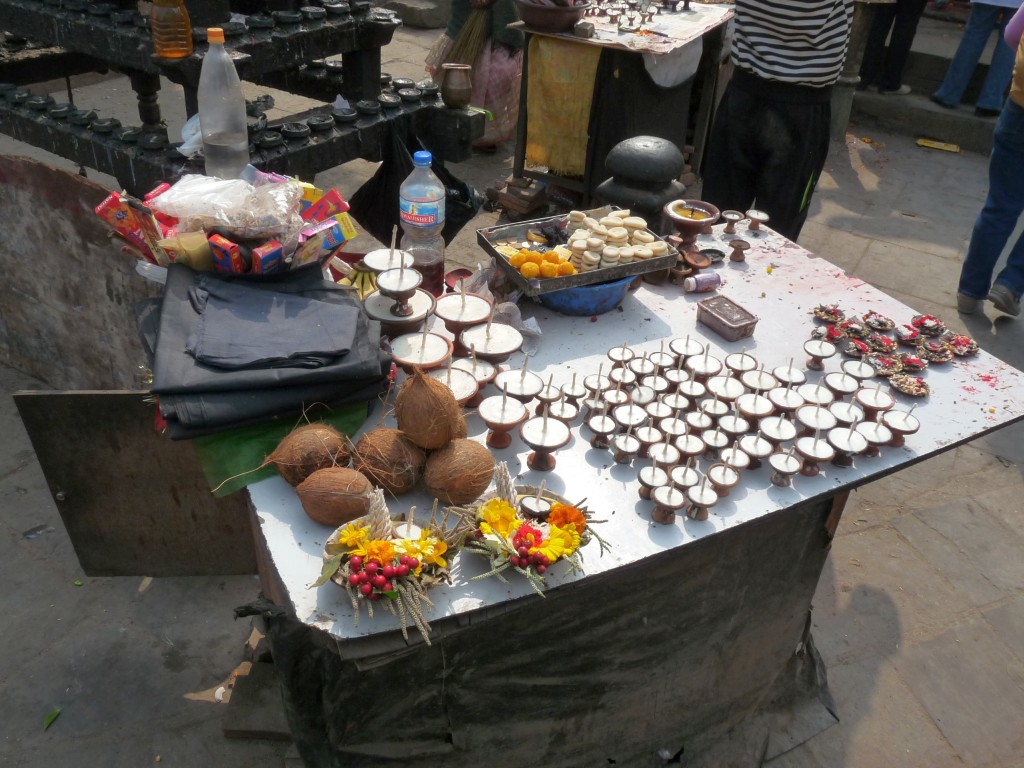
Further on, we found a colorful market there. This woman is selling bowls made from the leaves of the sal tree (Shorea robusta), and are used for religious offerings.


This is a sal tree (taken a week later at Chitwan National Park):


More of the market at Durbar Square


This woman is selling beans. Notice the cell phone she's holding!


Durbar Square is a place of religious devotion. Mostly of the Hindu faith.


This is famous image of Kali. People come here to state the truth; if you say something untrue, Kali will punish you.


Lots of pigeons (Columba livia) here.


Lugging a heavy load


Women singing


A Gurkha soldier stands guard


Then from Durbar Square, we walked back along an interesting shopping street.


An herbalist prepares a mixture.


A passing rickshaw driver


And for lunch:

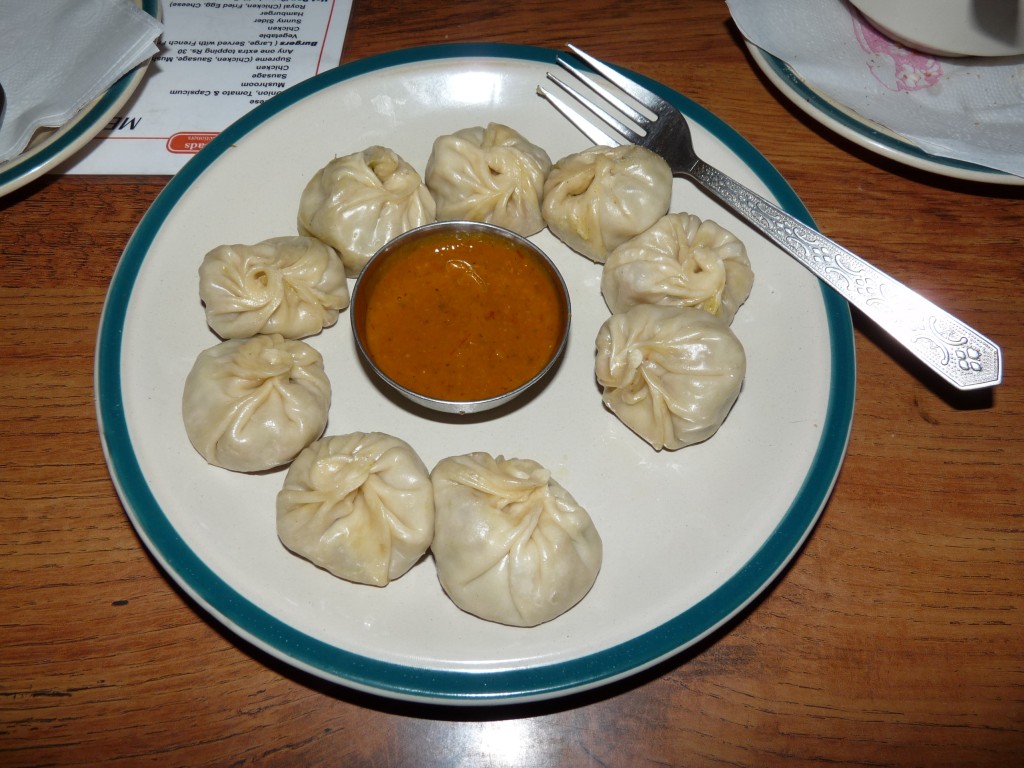
Momo. A Tibetan dumpling.

Tuesday, February 1, 2011

On the way

I'm sitting at the airport, awaiting a flight to Hong Kong. Then on to Kathmandu!

Friday, January 28, 2011

Trip to Nepal

Chinese New Year is coming up next week. Perfect time for a trip to Nepal: Feb 1-12. More to follow, Internet access permitting.

Intended itinerary:

Kathmandu
Pokhara
Chitwan National Park
Himalayan villages
Kathmandu

It will include a visit to the British Cemetery in Kathmandu. But there will be more than just cemetery visits, of course. After all, it's Nepal!!

Wednesday, January 5, 2011

Pavilion of Dreams

The Pavilion of Dreams is far and away the most popular pavilion of the Flora Expo, so much so that there's a rather Kafkaesque system for obtaining tickets. More about that later.

What can I say? Take cutting edge visual/interactive technology, add to it a generous helping of the Japanese "kawaii" aesthetic (you know: Hello Kitty, Sailor Moon, Pokemon, Totoro), stir in a steaming dollop of good ol' Chinese flowery rhetoric (artfully translated into Chinglish), season it with a dash of inadvertent (or perhaps advertent?) sexuality, and then add a powerful dose of shrooms. This is the Pavilion of Dreams.

First, you are led into a chamber to some rows of seats, where you are entertained for a few minutes by a flower-shaped mobile/chandelier thingy hanging from the ceiling, which opens and closes as it changes color.


After that thrilling event is overwith, you line up to be issued a bracelet. In the process, tall people like me have to squat down to read the monitor, which asks you to choose a life goal: career, health, emotion, and two others.... I forget. Why? Not really sure. The bracelet is used for the interactive stuff that comes up.

In the second room, you're presented with dozens of naked-eye 3D screens showing natural scenes. The technology that's used is a refinement of that used in old lenticular 3D postcards from the 70s, and it's actually pretty cool. You then stand in a green circle in front of a screen, and when cued by a light, you wave your hand. Sensors pick up the motion and "fairy dust" appears on the screen, making a flower grow. Kind of silly, but at least the plants you see are images of real ones you see when hiking in Taiwan's wildernesses.

You walk out, and you need to recharge your bracelet with "energy" (probably uploading some data for what comes up in the next room). And what you see in the next room defies belief. The theme of this room is the pollination of a flower. But you, imagining you're a bee, get to do the pollinating yourself. You are first invited to... I kid you not... "stroke the stamen". You approach several pendulous, testicular-looking objects hanging down from the ceiling, and you slap (rather than stroke) one of them. This supposedly releases the digital pollen.


Next you come to a curvy interactive screen where you "gather" "pollen." You wave your arm around, and the screen shows clusters of pollen gathering around your hand. Finally, charged with male DNA, you approach a large spherical ovule, which you plant your hand on and "impregnate," sparking a cascade of light that spreads outward and upward. ... Was it good for you?


Next you enter a hallway, where you place your bracelet in an energy circle to find out what flower you bloomed. Now you walk up the ramp to the second floor. This is where the coolest part of the experience takes place. It's the 360-degree amphitheater. Here you sit on the floor and are taken on a visual journey up into the clouds, and soon you zip through the mountains of Taiwan. This is the highlight of the Pavilion of Dreams. After that, you are brought down into a forest, where you do more interactive stuff. A wave of the hand causes a tree to spring up on screen, and touching a lighted area causes animals to come out.

Next you walk into another room where you're entertained by plastic cylinders that bob up, squat down and change color.


And finally, you walk to a table where you upload the data from your bracelet. The data is displayed on the tabletop screen, and it turns into flower, which joins everyone else's flowers. Woohoo.

You return your bracelet, and are given a souvenir/fortune card. You exit out a walkway lined with plastic bottles.

Drawbacks: Getting tickets is a real pain in the ay, the pavilion isn't everything it's cracked up to be, in my opinion. With the technology they had, they had the potential to do something much more awesome.

Advantages: Some of the technology used is very nice, and the visual flight through the mountains of Taiwan is awesome. And it's just a very bizarre, kitschy experience; an "only in Taiwan" kind of thing.

My rating: 4 stars (out of 5).

---

About getting tickets:

There's a special ticketing area outside the expo grounds. It's by the Xinsheng Park Area, at a gateway that's about 100m east of the main Expo entrance on Minzu East Road.

The gate to the Pavilion of Dreams ticketing area opens at 7:00am. Make sure you have an Expo ticket for the day. Once secured, you walk in, and there's an open flat area (used to be tennis and basketball courts) with plastic dividers allowing for about 20 rows of people to line up in switchback fashion. There are yellow dots on the ground, and each person gets to stand (or sit) on one (this is smart - it makes keeps people from crowding each other out, and makes it easier for the staff to estimate the crowd size).


For the next two hours you sit and chat with your neighbors, read a book, listen to mp3s, whatever.

At 9:00am, they close the gate to the area, and the line starts moving. You file through a special entrance to the park, and they check your Expo ticket. Then they finally hand you the coveted Pavilion of Dreams ticket (no charge, of course)! Your entry time for the pavilion may be several hours later.

Best to show up around 7:00am. Believe me, it was not easy for me. I am not a morning person!

Flora Expo

If you live in Taiwan and haven't heard of the Taipei International Flora Expo, something is seriously wrong with you. People outside of Taiwan can be forgiven of their ignorance.

The Expo has been going on since November 6, 2010, and will continue through April 25, 2011. In the months leading up to it I translated a number of articles about it, and I was even part of a team doing some signage translations for the Expo itself. (There are also a lot of poorly done signs. Our team is not responsible for those!) Because of this, I feel a kind of affinity to it... a love/hate relationship with it, if you will. And because of this, I bought myself a season pass for the princely sum of NT$2500 (about US$83) so I can attend anytime I wish. (The fact that it's 4 MRT stops from the office is a plus... I can just go before or after work.)

One thing I noticed is that despite the Expo entering it second month, there's an odd lack of reviews of the Expo, in English at least. So I am taking it upon myself to write my own reviews. I will do so pavilion by pavilion.