The Zombie is another classic tiki drink. This one was invented by Don the Beachcomber in 1934.
The problem with the Zombie is that there is no set recipe. Donn Beach kept his recipes secret, so much so that he prepared various mixes so that even his bartenders wouldn't know exactly what went in them. To confuse things further, he changed his recipe several times over the decades. On top of this, other bars attempted to reproduce the drink, or else they just created their own versions. Trader Vic's version is quite different from Don the Beachcomber's version, for example.
The common thread connecting all these recipes is the combination of at least three rums with at least three fruit juices, plus some additional flavorings (syrups, bitters and/or liqueurs).
The following recipe is an attempt to reconcile three different recipes known to originate from Don the Beachcomber:
1 oz light rum
1 oz gold rum
1 oz dark rum
3/4 oz. fresh lime juice
1/2 oz. grapefruit juice
1 1/2 oz. unsweetened pineapple juice
1/2 oz. falernum (a syrup with lime, ginger and almond flavors)
1/2 oz. grenadine
2 dashes Angostura bitters
1 oz. 151-proof rum
6 drops Pernod
Shake everything but the last two ingredients, and strain into tall glass filled with crushed ice. Float 151-proof rum and Pernod. Garnish with mint sprig.
No photo this time: too many ingredients I don't have at my disposal!
Tuesday, June 15, 2010
Monday, June 14, 2010
Mai Tai - again
While in the US I attempted to go to Trader Vic's to try their Mai Tai. I went to the Emeryville location, which turned out to be closed for renovations.
So I waited until I returned to Taiwan. There's a branch of Trader Vic's that's about a five-minute walk from my apartment. So I went there, sat at the bar, and was served a Mai Tai the way it was meant to be made.
Maita'i roa!

So I waited until I returned to Taiwan. There's a branch of Trader Vic's that's about a five-minute walk from my apartment. So I went there, sat at the bar, and was served a Mai Tai the way it was meant to be made.
Maita'i roa!


Tuesday, June 8, 2010
Piña Colada
The origins of the Piña Colada can be traced back to a refreshing drink sold on the streets of Cuba in the very early 20th century. It was called Piña Fria (cold pineapple), and consisted of the juice of a mashed piña (pineapple) with ice and sugar. The buyer could request that this drink be strained. The Spanish word for "strained" is colada.
It's known that rum was sometimes added to this drink in the 1920s, and someone came up with the idea of adding coconut milk (but no rum) in the 1930s. The first printed reference of a "piña colada" consisting of rum, pineapple juice and coconut milk is from a New York Times article in 1950.
In 1954, something interesting happened. That was the invention of "cream of coconut", a thick, creamy syrup made from coconut milk and sugar. The brand developed is called Coco Lopez.
That same year, so the legend goes, Ramon "Monchito" Marrero, a bartender at the Beachcomber Bar at the Caribe Hilton in San Juan, Puerto Rico, was asked by the hotel management to come up with a signature cocktail for the bar. After some months of experimentation, he perfected a simple yet exotic Piña Colada recipe using Coco Lopez cream of coconut, served as a blended drink. This recipe endures to this day, and Coco Lopez is the industry standard for those who wish to make the best quality Piña Coladas (as opposed to taking the easy way out and using "Piña Colada mix").
The popularity of this drink was given a major boost in 1979 with the release of Rupert Holmes' hit single Escape, also known as the Piña Colada Song.
Basic recipe:
1 part light Puerto Rican or Cuban rum
1 part cream of coconut
2-3 parts unsweetened pineapple juice
Blend in a blender and pour into tall glass; otherwise shake and strain, and pour into tall glass with ice. Garnish with pineapple slice and cherry. Add a straw. A cocktail umbrella would look nice too!
Bartenders have innovated upon this basic recipe by adding chopped pineapple (in blended drinks), Malibu (a coconut flavored rum), lime juice, orange juice, cream, rum floats, and much more. It doesn't hurt to add your own touch!
(I used a golden Jamaican rum here. Tasted very good!)

It's known that rum was sometimes added to this drink in the 1920s, and someone came up with the idea of adding coconut milk (but no rum) in the 1930s. The first printed reference of a "piña colada" consisting of rum, pineapple juice and coconut milk is from a New York Times article in 1950.
In 1954, something interesting happened. That was the invention of "cream of coconut", a thick, creamy syrup made from coconut milk and sugar. The brand developed is called Coco Lopez.
That same year, so the legend goes, Ramon "Monchito" Marrero, a bartender at the Beachcomber Bar at the Caribe Hilton in San Juan, Puerto Rico, was asked by the hotel management to come up with a signature cocktail for the bar. After some months of experimentation, he perfected a simple yet exotic Piña Colada recipe using Coco Lopez cream of coconut, served as a blended drink. This recipe endures to this day, and Coco Lopez is the industry standard for those who wish to make the best quality Piña Coladas (as opposed to taking the easy way out and using "Piña Colada mix").
The popularity of this drink was given a major boost in 1979 with the release of Rupert Holmes' hit single Escape, also known as the Piña Colada Song.
Basic recipe:
1 part light Puerto Rican or Cuban rum
1 part cream of coconut
2-3 parts unsweetened pineapple juice
Blend in a blender and pour into tall glass; otherwise shake and strain, and pour into tall glass with ice. Garnish with pineapple slice and cherry. Add a straw. A cocktail umbrella would look nice too!
Bartenders have innovated upon this basic recipe by adding chopped pineapple (in blended drinks), Malibu (a coconut flavored rum), lime juice, orange juice, cream, rum floats, and much more. It doesn't hurt to add your own touch!
(I used a golden Jamaican rum here. Tasted very good!)

Friday, June 4, 2010
Singapore Sling
Most bar books will tell you a Singapore Sling is gin, lemon juice, cherry brandy and club soda. Essentially a Tom Collins with cherry brandy. But the Singapore Sling as served at the place it was invented--the Raffles Hotel in Singapore--has a somewhat different recipe. Fruitier and with more ingredients, and no club soda.
The Singapore Sling is perhaps the original tropical cocktail (if we disregard old colonial potations like Navy Grog or Planter's Punch), predating the tiki era by a good two decades. Legend has it that it was invented about 100 years ago by a bartender named Ngiam Tong Boon (嚴崇文). Now this concoction has pretty much become Singapore's national drink, though even in Singapore, few know how to make it properly. Even at the Raffles, if they're busy, they'll probably serve you a pre-mixed drink squeezed into a dinky glass from a soda gun, and charge you a pretty penny for the honor. Sad.
What to do? As the old saying goes, "If you want it done right, do it yourself."
Here's the authentic recipe:
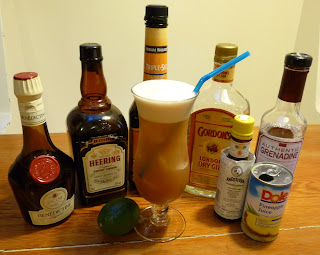
1 oz. gin (the Raffles uses Gordon's)
1/4 oz. Cointreau
1/2 oz. Cherry Heering
1/4 oz. Benedictine
1/2 oz. lime juice
4 oz. pineapple juice
1/3 oz. grenadine
1 dash Angostura bitters
Shake & strain into tall glass and garnish with cherry and slice of pineapple.
One interesting ingredient is Benedictine, an herbal liqueur developed exactly 500 years ago (in 1510). I couldn't find my Cointreau bottle, so I substituted triple sec. I also suspect it would look redder if I used Rose's Grenadine; instead I used 100% natural grenadine, which gives less intense color but better flavor.
If you want a more alcoholic drink, add more gin.
Looks good in a hurricane glass, does it not?
The Singapore Sling is perhaps the original tropical cocktail (if we disregard old colonial potations like Navy Grog or Planter's Punch), predating the tiki era by a good two decades. Legend has it that it was invented about 100 years ago by a bartender named Ngiam Tong Boon (嚴崇文). Now this concoction has pretty much become Singapore's national drink, though even in Singapore, few know how to make it properly. Even at the Raffles, if they're busy, they'll probably serve you a pre-mixed drink squeezed into a dinky glass from a soda gun, and charge you a pretty penny for the honor. Sad.
What to do? As the old saying goes, "If you want it done right, do it yourself."
Here's the authentic recipe:
1 oz. gin (the Raffles uses Gordon's)
1/4 oz. Cointreau
1/2 oz. Cherry Heering
1/4 oz. Benedictine
1/2 oz. lime juice
4 oz. pineapple juice
1/3 oz. grenadine
1 dash Angostura bitters
Shake & strain into tall glass and garnish with cherry and slice of pineapple.
One interesting ingredient is Benedictine, an herbal liqueur developed exactly 500 years ago (in 1510). I couldn't find my Cointreau bottle, so I substituted triple sec. I also suspect it would look redder if I used Rose's Grenadine; instead I used 100% natural grenadine, which gives less intense color but better flavor.
If you want a more alcoholic drink, add more gin.
Looks good in a hurricane glass, does it not?


Tuesday, June 1, 2010
Mai Tai
The Mai Tai is one of the great and enduring drinks from the heyday of the tiki culture. The tiki craze started after the lifting of Prohibition. At the time, rum was cheap and plentiful, and two entrepreneurs, first Donn Beach and then Trader Vic (Victor Bergeron) opened bars and restaurants with Polynesian-inspired themes. In these establishments, exotic rum-and-fruit based concoctions were created and enjoyed. The craze was further propelled in the 1940s when soldiers returned from fighting in the Pacific, and in the 1950s when Hawaii gained statehood. By the 1970s, the craze petered out, being seen as tacky and unauthentic. But now tiki culture, just as in the case of classic cocktails, is experiencing a revival.
The Mai Tai is a misunderstood drink. It's often thought of as an exotic red concoction with several fruit juices, such as pineapple and orange juice. But the only fruit juice in a true Mai Tai is lime juice. It's not even garnished with fruit: the proper garnish is a sprig of mint. And it's not red! Please! Trader Vic would spin in his gra... I mean in his columbarium niche at Mountain View Cemetery. A properly made Mai Tai has an amber-yellow color.
The Mai Tai was invented by Trader Vic in his restaurant in Oakland, California, in 1944. He threw together a special rum drink for friends who were visiting from Tahiti, and when one of them tasted it, she said "Maita'i roa a'e!", which means "Very good!" So Vic called it the Mai Tai.
Here's the authentic recipe:
2 oz. aged Jamaican rum
1 oz. fresh lime juice
1/2 oz. DeKuyper orange curacao
1/2 oz. orgeat (an almond syrup)
1/4 oz. sugar syrup
Shake the ingredients, and strain into a double rocks glass filled with crushed ice. Add a half lime shell (it's supposed to look like an island), garnish with a mint sprig or two, and add a straw. Then smile!

Delicious!
The Mai Tai is a misunderstood drink. It's often thought of as an exotic red concoction with several fruit juices, such as pineapple and orange juice. But the only fruit juice in a true Mai Tai is lime juice. It's not even garnished with fruit: the proper garnish is a sprig of mint. And it's not red! Please! Trader Vic would spin in his gra... I mean in his columbarium niche at Mountain View Cemetery. A properly made Mai Tai has an amber-yellow color.
The Mai Tai was invented by Trader Vic in his restaurant in Oakland, California, in 1944. He threw together a special rum drink for friends who were visiting from Tahiti, and when one of them tasted it, she said "Maita'i roa a'e!", which means "Very good!" So Vic called it the Mai Tai.
Here's the authentic recipe:
2 oz. aged Jamaican rum
1 oz. fresh lime juice
1/2 oz. DeKuyper orange curacao
1/2 oz. orgeat (an almond syrup)
1/4 oz. sugar syrup
Shake the ingredients, and strain into a double rocks glass filled with crushed ice. Add a half lime shell (it's supposed to look like an island), garnish with a mint sprig or two, and add a straw. Then smile!

Delicious!
Monday, May 31, 2010
On drink recipes
Here are a few things that bother me when I see them in cocktail recipes, with my solutions on how to deal with them.
1. "Juice of one something-or-other" ("juice of one lime", "juice of one lemon", etc.) This is just asking for inaccuracy and inconsistency. The problem is that lemons and limes vary in size. No recipe should be written this way, in my opinion. If you come across a recipe written like this, here's my solution: an average lime contains about 1 ounce of juice; an average lemon about 1 1/2 ounces. Then be sure to taste the resulting cocktail to check for balance.
2. Sour mix. This artificially sweetened lemon-like concoction is the friend of the lazy bartender, and store-bought brands are usually chock full of artificial flavorings and colorings. Ugh! And many bars have taken to using sour mix in a Margarita, a drink that requires lime, not lemon. In recipes (other than those for Margaritas) that call for sour mix, for every ounce of sour mix, use 1/2 ounce of fresh lemon juice and 1/2 ounce of sugar syrup.
3. Jigger or shot. A jigger or shot can be anywhere between 1 ounce (at many cheapskate bars) to 2 ounces (standard shot at a bar I worked at several years ago). My opinion? One shot or jigger should be 1 1/2 ounces, and nothing else. This is how I learned it back in the 80s and early 90s. The 1 oz shot seems to be an innovation of the late 90s and 2000s. But without exception, unless your boss says otherwise, default to 1 shot = 1 1/2 oz (45 ml). If a recipe calls for a 1 oz. shot, it should just say "1 oz".
4. Wild deviations from norms. Nothing wrong with variations: bars and bartenders come up with their own special touches to drinks, just like restaurants and chefs do with dishes; also, many recipes evolve well over time. Recipes vary from book to book, and that gives the bartender room to experiment with. But some recipes change so drastically over time and from region to region that they bear little resemblance to the original. If so, its time to give the drink a new name. A prime example is the Mai Tai. Originally, the only fruit juice was lime, but many versions nowadays call for pineapple juice, orange juice and grenadine (not in the original recipe), and omit the almond syrup and lime. It may be a tasty drink, but it's not a Mai Tai. I'll give the Mai Tai a treatment in a future post. The only solution to this problem is to do research. Look at different books, check the Internet.
1. "Juice of one something-or-other" ("juice of one lime", "juice of one lemon", etc.) This is just asking for inaccuracy and inconsistency. The problem is that lemons and limes vary in size. No recipe should be written this way, in my opinion. If you come across a recipe written like this, here's my solution: an average lime contains about 1 ounce of juice; an average lemon about 1 1/2 ounces. Then be sure to taste the resulting cocktail to check for balance.
2. Sour mix. This artificially sweetened lemon-like concoction is the friend of the lazy bartender, and store-bought brands are usually chock full of artificial flavorings and colorings. Ugh! And many bars have taken to using sour mix in a Margarita, a drink that requires lime, not lemon. In recipes (other than those for Margaritas) that call for sour mix, for every ounce of sour mix, use 1/2 ounce of fresh lemon juice and 1/2 ounce of sugar syrup.
3. Jigger or shot. A jigger or shot can be anywhere between 1 ounce (at many cheapskate bars) to 2 ounces (standard shot at a bar I worked at several years ago). My opinion? One shot or jigger should be 1 1/2 ounces, and nothing else. This is how I learned it back in the 80s and early 90s. The 1 oz shot seems to be an innovation of the late 90s and 2000s. But without exception, unless your boss says otherwise, default to 1 shot = 1 1/2 oz (45 ml). If a recipe calls for a 1 oz. shot, it should just say "1 oz".
4. Wild deviations from norms. Nothing wrong with variations: bars and bartenders come up with their own special touches to drinks, just like restaurants and chefs do with dishes; also, many recipes evolve well over time. Recipes vary from book to book, and that gives the bartender room to experiment with. But some recipes change so drastically over time and from region to region that they bear little resemblance to the original. If so, its time to give the drink a new name. A prime example is the Mai Tai. Originally, the only fruit juice was lime, but many versions nowadays call for pineapple juice, orange juice and grenadine (not in the original recipe), and omit the almond syrup and lime. It may be a tasty drink, but it's not a Mai Tai. I'll give the Mai Tai a treatment in a future post. The only solution to this problem is to do research. Look at different books, check the Internet.
Irish Coffee
In the 1950s, a sweetened coffee drink, spiked with Irish whiskey and topped with cream, was served in a lounge at Shannon Airport, Ireland. Impressed by this drink during a visit to Ireland, San Francisco Chronicle writer Stanton Delaplane worked with the owners of the Buena Vista Cafe in SF to reproduce and perfect the technique of making this drink. This was accomplished in 1952. The fame of this beverage spread, and the cafe is now renowned for it. It's called the Irish Coffee.
We visited the Buena Vista Cafe yesterday, and I ordered one. Absolutely wonderful! You don't stir it; you just drink it through the cream, and there's a great feeling of contrast between the heat of the coffee and the cold of the cream.

Recipe:
Fill hot Irish Coffee mug 3/4 full with coffee.
Add 2 sugar cubes and stir until they are dissolved.
Add 1 1/2 oz. Irish whiskey (Buena Vista Cafe uses Tullamore Dew).
Top with lightly whipped whipping cream, poured gently over a spoon.
A cable car passes in front of the Buena Vista Cafe

We visited the Buena Vista Cafe yesterday, and I ordered one. Absolutely wonderful! You don't stir it; you just drink it through the cream, and there's a great feeling of contrast between the heat of the coffee and the cold of the cream.

Recipe:
Fill hot Irish Coffee mug 3/4 full with coffee.
Add 2 sugar cubes and stir until they are dissolved.
Add 1 1/2 oz. Irish whiskey (Buena Vista Cafe uses Tullamore Dew).
Top with lightly whipped whipping cream, poured gently over a spoon.
A cable car passes in front of the Buena Vista Cafe

Subscribe to:
Posts (Atom)