Thursday, September 30, 2010

Language mystery solved

Last month, after going to Singapore, I visited a friend in Bangkok. While there I went to the Royal Cemetery at Wat Ratchabophit, final resting place of many relatives of King Chulalongkorn, grandfather of the current king of Thailand. The current king's parents and sister are also interred in this cemetery.

In the southwestern corner of the cemetery I found this interesting mausoleum:


Curious as to who is buried here, I took a photo of the brass plaques on the doors, in hopes of deciphering the inscription later.


Later, when I was examining the inscription, I noticed something odd. These are Thai letters, all right, but something is a little off.

First, there were too many spaces between the words. The Thais run their words together, using spaces as we would use a comma or period in English.

Next, some of the characters had a dot under them. There is no such symbol in ordinary Thai.


Third, some of the characters had a small circle over them. But in Thai the circle is always paired with a long-A symbol. Most of these circles were not.


I realized that what I was looking at wasn't Thai at all, but Sanskrit or Pali. So to decipher it, I would have to map the Thai letters to their Sanskrit/Pali sounds rather than their modern spoken sounds. In Thai script, all consonants are followed by an inherent vowel sound, and the dot cancels it. Thus, the first close-up word above is dha + m + ma + a, or dhammā. The little circle represents a postvocalic nasal (-m), so the second close-up word above is he + tu + m, or hetum.

And dhamma is a Pali word. It's in Pali!! After that, all I needed to do was map the letters. The result:

Ye dhamma hetuppabhava,
tesam hetum tathagatho aha;
tesam ca yo nirodho.
Evam vadi mahasamano.

Sabbe sankhara aniccati
yada pannaya passati
atha nibbindati dukkhe
esa maggo visuddhiya.

Sabbe sankhara dukkhati
yada pannaya passati
atha nibbindati dukkhe
esa maggo visuddhiya.

Sabbe dhamma anattati
yada pannaya passati
atha nibbindati dukkhe
esa maggo visuddhiya.

And Google was kind enough to point me to websites with the translation. The first stanza is a famous quote by (someone!), and the following three stanzas are verses from the Dhammapada:

Of things that proceed from a cause,
their cause the Tathagata has told;
and also their cessation.
Thus teaches the great ascetic.

All conditioned phenomena are impermanent;
when one sees this with wisdom,
one becomes weary of suffering.
This is the path to purity.

All conditioned phenomena are suffering;
when one sees this with wisdom,
one becomes weary of suffering.
This is the path to purity.

All dharmas are without self;
when one sees this with wisdom,
one becomes weary of suffering.
This is the path to purity.

Mystery solved. But it didn't answer my original question: who is buried here?

I later found from a Thai website that among those interred in this intriguing mausoleum is Bhumi Jensen, the king's Thai-American grandson who tragically died in the great tsunami of 2004 while vacationing in southern Thailand.

Sunday, September 12, 2010

Swan Boat at Bitan

Swan boat at Bitan, Xindian, Taiwan

Sunday, August 15, 2010

Flora and Fauna from my trip

Sorry about the delay. My mouse broke and Internet connection was slow and spotty.

After visiting the Raffles Hotel, I went back to Fort Canning Park to explore it some more. And what should I see, on a public footpath, but a Paradise Flying Snake that had caught a frog! Right there in a city park! Beautiful snake, and not harmful to humans.

Paradise Flying Snake (Chrysopelea paradisi)


Fort Canning Park is filled with great vegetation, some of which has signage. This didn't, but it's known as the Lobster Claw.

Lobster Claw (Heliconia rostrata)


Within the park is the Spice Garden, which features various important herbs and spices of the region. Here's the Laksa Leaf, an ingredient in a local curry noodle dish called Laksa.

Laksa Leaf (Polygonum odoratum)


The Cannonball Tree, an amazing tree originally from South America, but popular and often considered sacred in India and Southeast Asia.

Cannonball Tree (Couroupita guianensis)


The Betel Pepper is a leaf that the nut of the Areca Palm (Areca catechu) is wrapped in to create betel nut, which, with the addition of lime (calcium oxide), people chew for a light buzz.

Betel Pepper (Piper betle)


The Sacred Fig or Bodhi Tree is the tree the Buddha is said to have sat under when he attained enlightenment. Saplings of this tree can often be found growing on walls and roofs because birds eat the fruits and spread them around.

Sacred Fig (Ficus religiosa) growing from a wall


All of the above were from Singapore. The following Common Lime Butterfly is one I saw a couple days later in Bangkok.

Common Lime Butterfly (Papilio demoleus)
on Flame of the Woods (Ixora coccinea)

Wednesday, August 11, 2010

The Singapore Sling

On Tuesday I went to visit the Raffles Hotel. This storied hotel is the classic place to stay in Singapore... if you have the money.


It was here, about 100 years ago, that the Singapore Sling is said to have been invented. Today, drinking a Singapore Sling at the Raffles is on the "must do" list for tourists. The place to go for the classic Singapore Sling is the Long Bar.


Inside the Long Bar


And here it is: the Singapore Sling.


The Singapore Sling, as served by the Raffles Hotel, is made according to a recipe painstakingly reconstructed after it had been lost for decades.

Now the bad news: it is expensive. When I first tried it 17 years ago, it cost US$6. Now it costs about US$19! Second, unless specifically arranged for in advance, they are pre-made. They simply fill the glass with a ready made drink. But the drink is made fresh in batches using the authentic ingredients. Third, when I tasted it, it was a little heavy on the grenadine, giving it a slightly cough-syrupy taste that overpowered the other flavors to some degree. I asked what brand they used and they informed me it was Bols Grenadine, which is a very good product. There was just a little too much in it. But grenadine is needed for the classic pink color.

Don't get me wrong, it's still an excellent cocktail, and drinking one in the place it was invented is a sublime experience for a cocktail enthusiast.

On the right: 3 of the 8 ingredients of the Singapore Sling.
On the left: a choice of gins.

Tuesday, August 10, 2010

Bidadari Cemetery

Singapore is not known for its cemeteries; if anything, it's more well known for its former cemeteries. In a tiny country like Singapore, land comes at a premium. To adapt with growing populations and need for resources, over the last 200 years there has been constant reallocation and reclamation of land. One victim of this desire for land is cemeteries.

The largest of these former cemeteries is the former Bidadari Cemetery. Exhumation of this beautiful, historic cemetery began around 1999, and was complete by 2005. Many of the bodies were relocated to Kranji and Chao Chu Kang. Others were reclaimed by family and relocated overseas. The rest were cremated and committed to the sea under supervision of clergy. Records were made and are apparently kept in the Singapore National Archives.

Curious, I went to the former site to look around. What I found was an expanse of grassy parkland. The only thing that remains of the original cemetery is the roads within the park. There's not a single grave left, of around 58,000, as far as I could tell.
This is what it looks like now:


Nevertheless, the historic gateway and some of the graves of the most prominent people were preserved. They were located nearby to a place called Bidadari Garden. Within here 21 graves are preserved .

Gateway


The former Bidadari Cemetery was divided into two sections: the Christian section and the Muslim section. Likewise, Bidadari Garden has Christian and Muslim sections.

Two paths: Christian on left, Muslim on right


Next to Bidadari Garden is another cemetery: Mount Vernon Columbarium. It is actually a collection of columbaria, including a prominent pagoda-like lingguta, or "spirit bone tower".


I found this name amusing.


OK, next entry won't have anything to do with graves. I promise!

Monday, August 9, 2010

Kranji War Cemetery

After leaving the Merlion, I walked a bit along the Singapore River to the MRT station.

Old buildings along Singapore River


Next stop only first full day was Kranji War Cemetery. It's a Commonwealth War Graves Commission cemetery dedicated to those who died defending Singapore against the Japanese in World War II.

Kranji War Cemetery


Cross of Sacrifice


Next to Kranji War Cemetery is the State Cemetery. Only two people are buried here so far; one of them is Dr. Benjamin Henry Sheares, the first president of the Republic of Singapore.


Grave of Benjamin Henry Sheares


Then I returned. Once back in Chinatown I stopped at the Buddha Tooth Temple for a spell.

A wall of Buddhas


I'll have to explore that temple more.

Then I got together with my friend Harry and some of his co-workers and did a little pub crawling. Drank many beers. Some of the bars were pretty wild. That's another story.

Singapore

I had frequent flyer miles I needed to redeem, so I decided to fly out to Singapore. Then next weekend I'll be returning to Taiwan from Bangkok. Not bad for a free plane ticket, eh?

I arrived at Singapore's Changi Airport, and took the MRT (subway) to Chinatown where the hostel I'm staying at is. When I exited the MRT station, the elevator brought me smack dab into the middle of a Chinatown tourist market. I have a love-hate relationship with it: there are beautifully restored 19th century buildings, but the place is a tourist trap: tacky souvenir shops, overpriced restaurants, and a sanitized, artificial "Chinese" ambiance.

Tourist market


Beautifully restored 19th century buildings


So anyway, onto my first day's activities. The first thing I did was go to Fort Canning Park. This is the location of an old fort that stood ready to defend Singapore for generations. The park also has a lot of interesting vegetation.

Fort Canning cannon


A plant (some species of Heliconia, I believe)


In the northeast part of the park is Fort Canning Green, which was once a cemetery. Now, 12 graves still stand in the northeast corner. The remaining gravestones, around 250 of them, were removed and are now mounted in the walls of the green.

Fern-covered south wall of Fort Canning Green


Remaining standing graves


Twin cupolas


Just outside the southwest corner of the green, but still within Fort Canning Park, is another grave: the Tomb of Iskandar Shah, a 14th century king of Temasek (former name of Singapore).


Next stop on my itinerary was the Armenian Church of St. Gregory the Illuminator. Here, in the lawn behind the church, are the tombstones of members of famous families. One of the tombs is of the woman who discovered the national flower of Singapore, the Vanda Miss Joaquim. The stones had been moved here from elsewhere.

Armenian Church


Tombstones (with Ravenala madagascariensis, the Traveler's Palm)


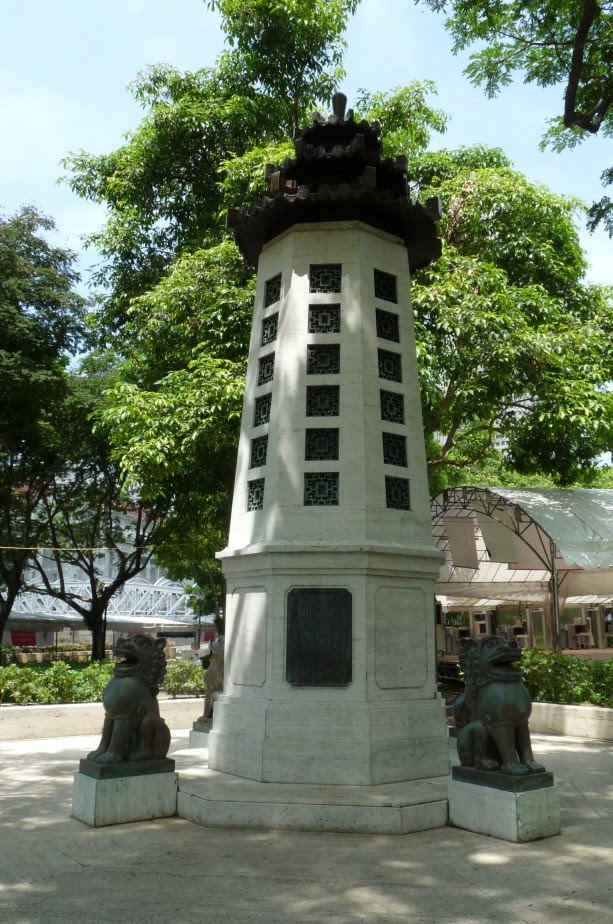
Next is the Memorial to Lim Bo Seng, down by the Esplanade. He was a hero of the Resistance against the Japanese during WWII. While visiting the memorial, a family was there visiting too. The man told be Lim Bo Seng was his great great uncle. His cute little daughter then said, "He's my great great great uncle!" He told me that his actual grave is up at MacRitchie Reservoir Park.

Lim Bo Seng Memorial


Finally, to the Merlion. Half lion, half fish, it's the symbol of Singapore.

The Merlion


It was only around noon, so I had time to go visit Kranji War Cemetery and the State Cemetery. This will be my next entry.